
High Fixed Carbon Coconut Charcoal in Metallurgy & Steel Foundries: The Low-Impurity Recarburizer
Discover why electric arc furnace (EAF) operators and ductile iron foundries are replacing fossil coke with high-purity coconut shell charcoal to eliminate sulfur contamination and slag defects.

Mawai Metallurgy Team
Thermal & Carbon Process Specialists
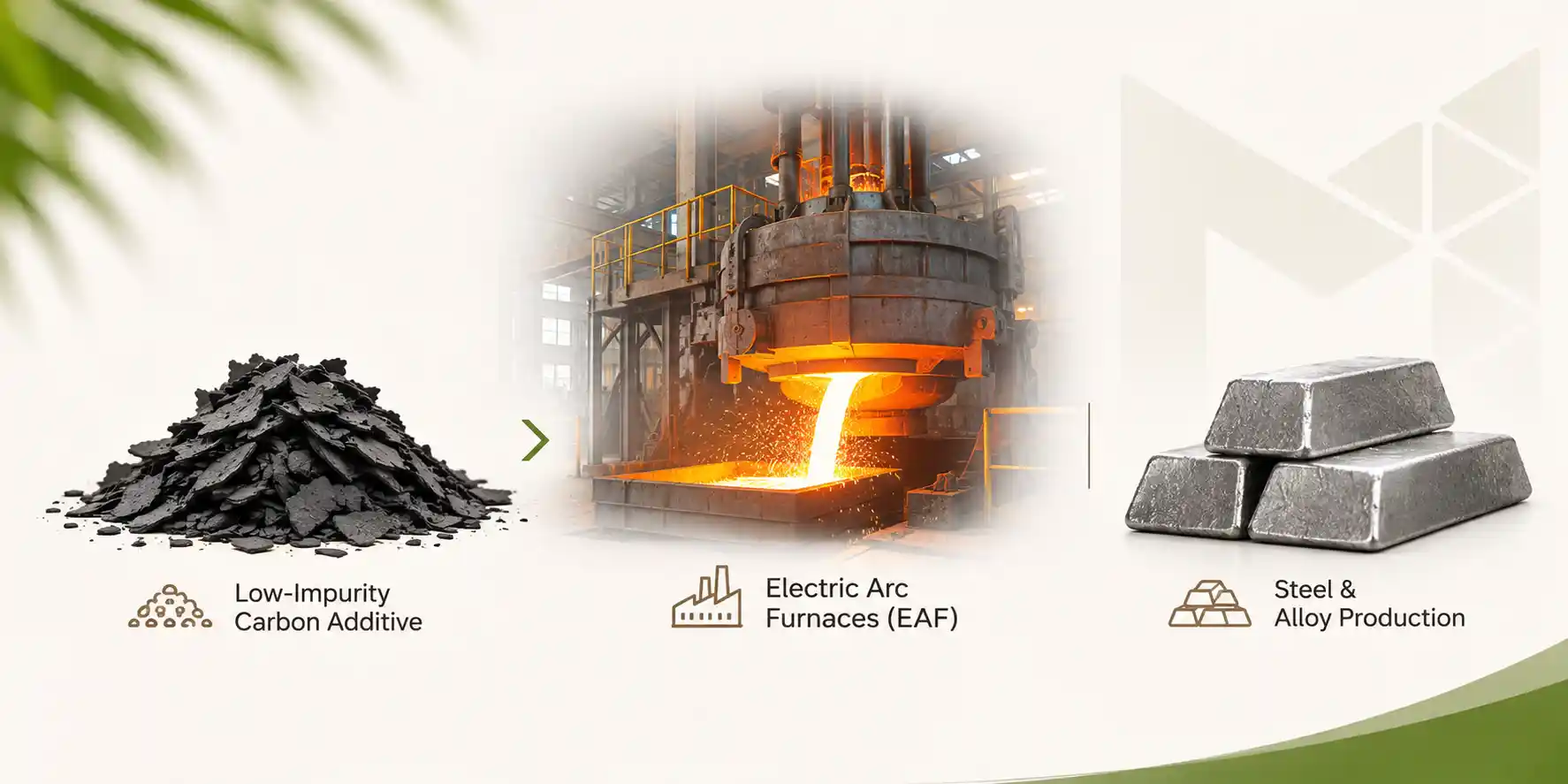 Visual Documentation // Metallurgy & Foundries
The Critical Role of Carbon Recarburizers in Modern Steelmaking
In electric arc furnace (EAF) steelmaking, ladle refining, and ductile iron foundries, carbon is not merely a fuel—it is the foundational alloying element that governs tensile strength, ductility, and microstructure hardness. Maintaining precise melt chemistry requires introducing high-purity recarburizers (carbon raisers).
Traditionally, foundries relied heavily on petroleum coke (calcined petcoke) or metallurgical coal coke. However, rising metallurgical purity requirements and stringent environmental standards have driven steelmakers to switch to high-purity coconut shell charcoal as a biogenic, low-impurity recarburizer.
1. Ultra-Low Sulfur (< 0.05%) Protects Alloy Integrity
Sulfur is notoriously detrimental in steel and ductile iron casting. High sulfur concentrations react with iron to form low-melting-point iron sulfide ($FeS$) inclusions along grain boundaries, triggering hot shortness, micro-cracking, and catastrophic brittleness during forging and rolling.
- Standard Petroleum Coke: Typically contains 0.5% to 2.5% sulfur, requiring heavy calcium carbide or magnesium desulfurization additions.
- Mawai Coconut Shell Charcoal: Naturally contains less than 0.05% sulfur. Using it as a charge carbon or trim recarburizer virtually eliminates sulfur pick-up, cutting desulfurization slag costs and ensuring superior ductile graphite nodularity.
2. Minimal Ash Content (< 3%) Lowers Slag Burden & Refractory Wear
Ash in recarburizers consists of refractory-degrading oxides like $SiO_2$, $Al_2O_3$, and $Fe_2O_3$. High-ash carbon additives form heavy, viscous slag layers that insulate melt pools, trap gases, and accelerate the corrosive wear of expensive magnesite and alumina furnace linings.
Mawai Coconut Shell Charcoal delivers an ultra-clean ash yield of less than 3.0%. This drastically decreases overall slag volume, speeds up dissolution, lowers electrical power consumption per metric tonne of liquid steel, and extends furnace refractory campaign life.
3. High Fixed Carbon (75%–80%) & Rapid Carbon Dissolution
Due to the dense, mature cellular matrix of coconut shells carbonized under controlled thermal conditions, our charcoal features high fixed carbon (75% to 80%) with minimal volatile matter (<15%). When charged into the furnace bath or tapped into transfer ladles, it exhibits high carbon absorption efficiency (>85% carbon recovery), minimizing carbon fade and delivering predictable metallurgical adjustments.
4. Consistent Slag Foaming Control
In EAF operations, controlled carbon injection into the slag layer reacts with iron oxide to generate uniform carbon monoxide ($CO$) bubbles. This creates a stable, foamy slag layer that shields the water-cooled furnace panels from the intense electric arc radiation, improving energy transfer efficiency by up to 15%.
Mawai Quality & Compliance Verified
Data verified against ASTM international testing standards and production batch analysis.
Related Technical Publications
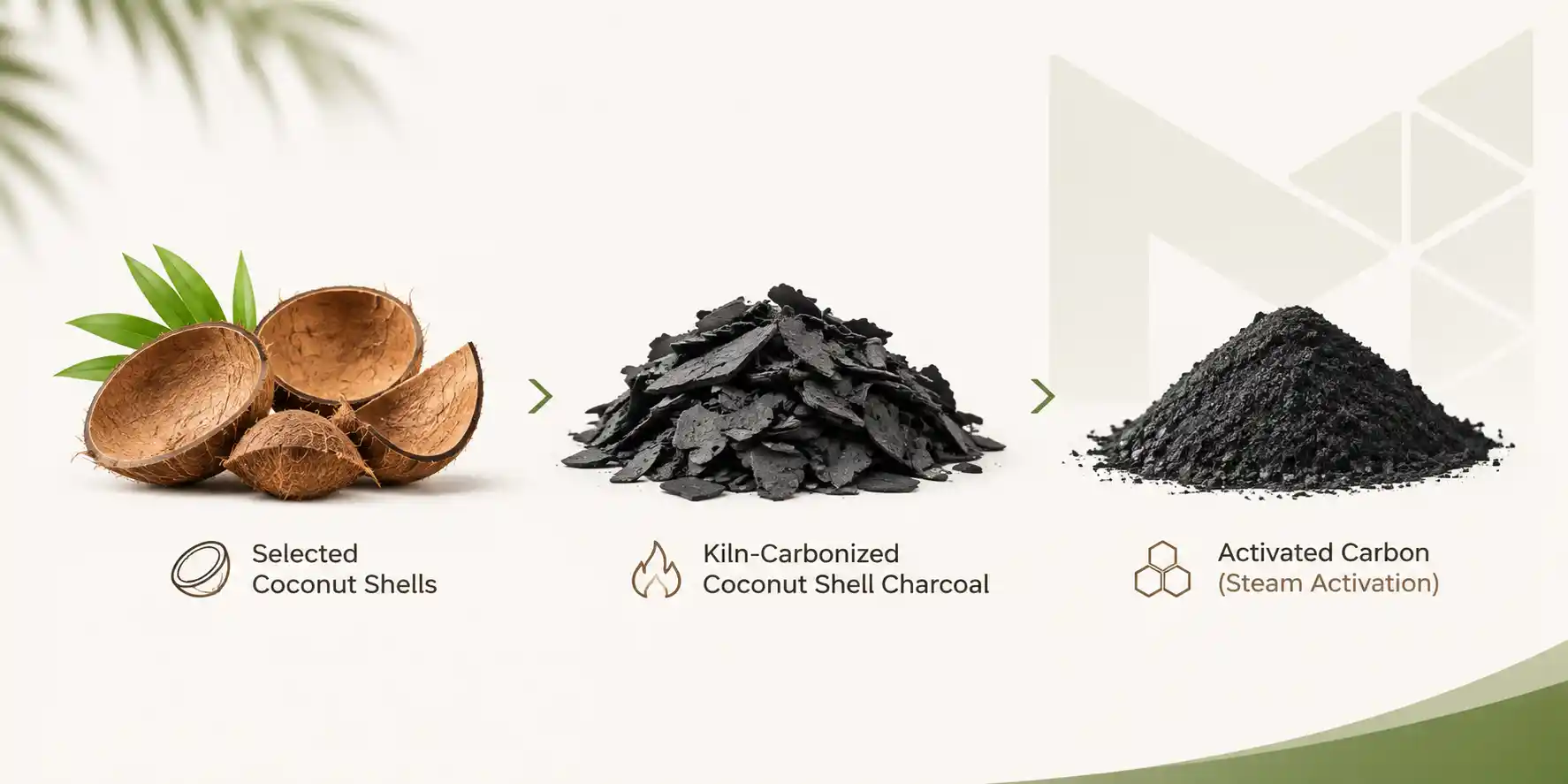
Why Steam Activation Plants Specify Coconut Shell Charcoal as Premium Feedstock
An engineering breakdown of how mature South Indian and Indonesian coconut shell charcoal yields world-class activated carbon with 1200 mg/g iodine and 98% mechanical hardness.
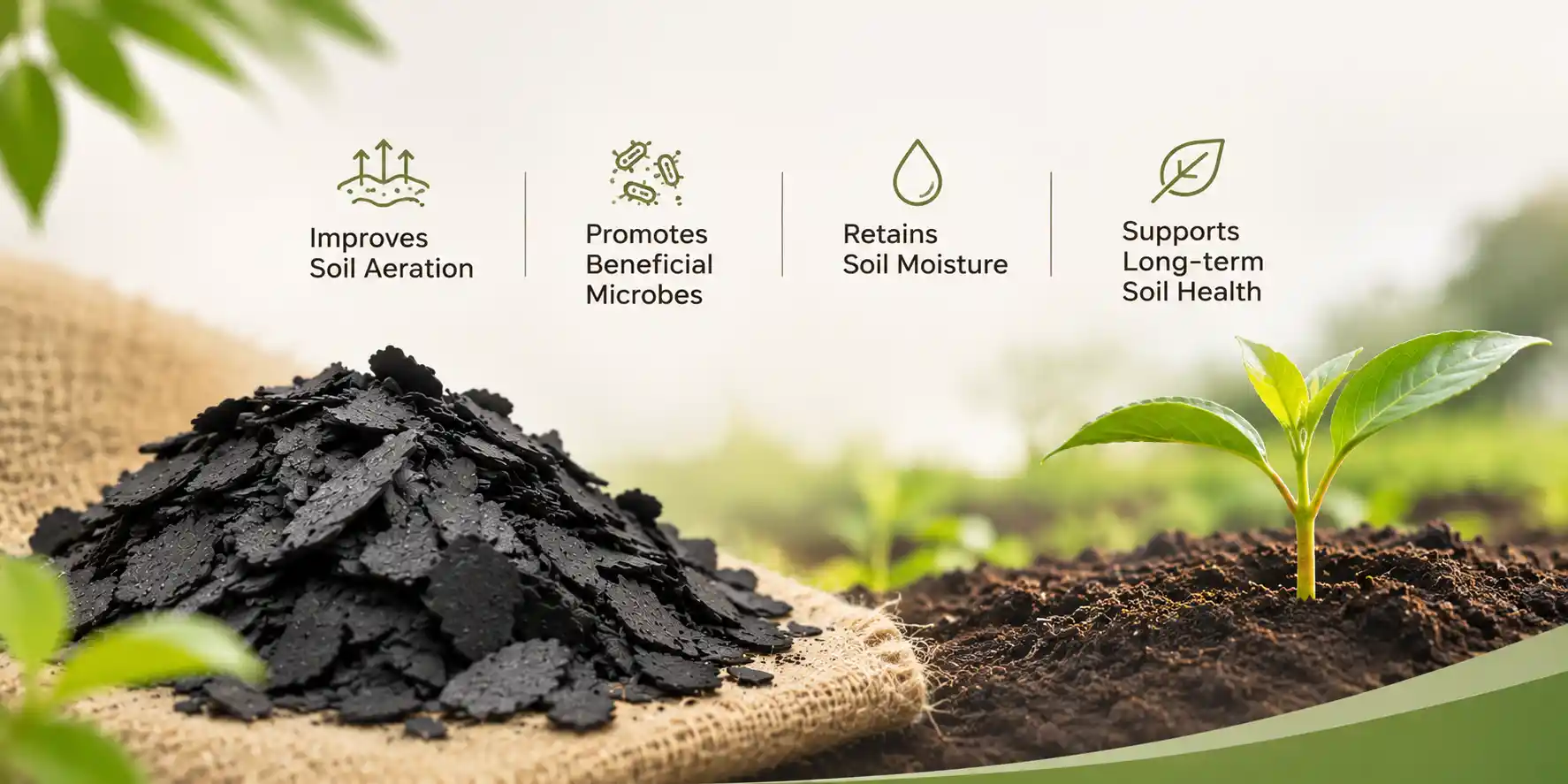
Coconut Shell Charcoal as High-Purity Biochar for Soil Regeneration & Sustainable Agriculture
How agricultural biochar produced from mature coconut shells restores depleted farmland soils, retains soil moisture by up to 30%, and sequesters biogenic carbon for centuries.
Looking For A Direct Coconut Shell Charcoal Manufacturer?
Partner with Mawai Carbon Industries for reliable container-load supply of premium coconut shell charcoal, fine carbon powder, and industrial activated carbon grades delivered worldwide.