
Optimizing Gold Recovery: Why Coconut Shell GAC Outperforms in CIP & CIL Circuits
Learn why precious metal mining engineers rely on high-hardness coconut granular activated carbon to maximize gold loading rates ($K$-value) and eliminate gold loss in tailings.

Mawai Mining Solutions
Industrial Extraction Engineers
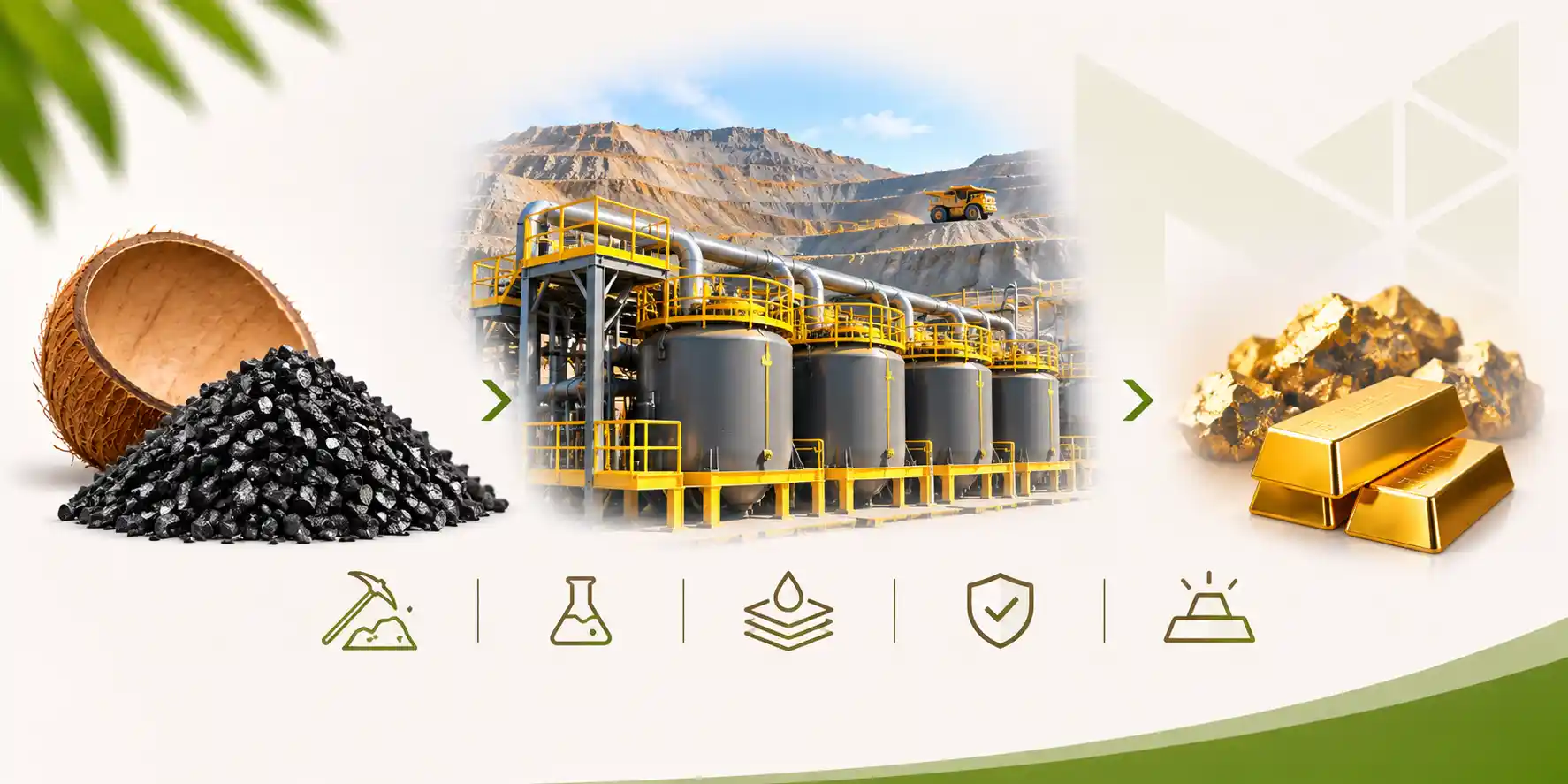 Visual Documentation // Gold Recovery & Mining
The Critical Role of Activated Carbon in Hydrometallurgical Gold Mining
In modern gold extraction operations utilizing Carbon-in-Pulp (CIP), Carbon-in-Leach (CIL), and Carbon-in-Column (CIC) circuits, gold is leached from mined ore using a dilute cyanide solution to form soluble gold cyanide complexes ($[Au(CN)_2]^-$).
Granular Activated Carbon (GAC) is added directly to the slurry to selectively adsorb the dissolved gold onto its internal micropores. Because the value of the loaded carbon is exceptionally high, any physical degradation of the carbon directly results in lost revenue.
1. Preventing Gold Loss Through Attrition Resistance
Inside aggressive CIL agitation tanks, abrasive ore slurry is continuously stirred by high-speed impellers. If the activated carbon is soft or fragile, it shears into microscopic particles (<0.5 mm).
These broken carbon fines pass right through the interstage retention screens and are discharged into the tailings waste pond—taking their loaded gold with them. Mawai granular coconut carbon delivers a ball-pan hardness rating $ge 98%$, practically eliminating attrition loss and protecting mining profitability.
2. High Gold Adsorption Kinetics ($K$-Value) & Capacity ($R$-Value)
Mining operations evaluate carbon based on two primary metallurgical indicators:
- Kinetic Adsorption Rate ($K$-Value): The speed at which carbon extracts gold from the cyanide leach solution in the first contact hours.
- Equilibrium Capacity ($R$-Value): The total mass of gold that can be loaded per metric tonne of carbon before breakthrough.
Due to the pure coconut shell base, Mawai GAC features iodine numbers from 1000 to 1200 mg/g and CTC activity above 55%. This provides dense microporous active sites that accelerate $[Au(CN)_2]^-$ complex capture, allowing mining plants to maintain shorter contact retention times and reduce required carbon inventory.
3. Platelet-Free Particle Geometry
Standard wood- or coal-based carbons often contain flaky or elongated "platelet" particles that lodge into interstage retention screens, causing severe slurry blinding, tank overflow, and operational shutdowns. Our coconut shell GAC is subjected to precision rotary de-dusting and classification to ensure rounded, cubical grain geometry that flows smoothly across screening systems.
Mawai Quality & Compliance Verified
Data verified against ASTM international testing standards and production batch analysis.
Related Technical Publications
Activated Carbon for Water Filtration: PAC vs. GAC in Municipal & Industrial Treatment
A technical comparison between Powdered Activated Carbon (PAC) and Granular Activated Carbon (GAC) for municipal drinking water, wastewater remediation, and chemical processing.
Extruded Carbon Pellets (EAC) for Industrial Gas Scrubbing & VOC Emission Control
Engineering perspectives on using 3mm and 4mm cylindrical extruded activated carbon pellets for low-backpressure solvent recovery, hydrogen sulfide removal, and environmental air scrubbers.
Looking For A Direct Coconut Shell Charcoal Manufacturer?
Partner with Mawai Carbon Industries for reliable container-load supply of premium coconut shell charcoal, fine carbon powder, and industrial activated carbon grades delivered worldwide.